Developing crawlers for Politically Exposed Persons (PEPs)
If this is your first crawler, start with a basic one by following the tutorial, then come back here. For common approaches, look at the children of the peps collection.
Being classified as a PEP does not imply you have done anything wrong. The concept matters because PEPs and members of their families should be the subject of enhanced public scrutiny, which is also mandated by financial crime laws in many countries. Read more about the PEP data.
How a PEP is modeled
A PEP is represented as three linked entities:
- a Person — the individual.
- a Position — the political role that confers exposure (e.g. Member of the Bundestag), defined independently of who holds it.
- an Occupancy — the time-bounded link recording that a person held a position over some period.
So one person who has held two roles produces one Person, two Positions, and two Occupancies.
make_occupancy is the linchpin: it builds the
Occupancy, sets its status, adds the role.pep topic to the person, and
returns nothing once political exposure has lapsed. A person should be emitted as
a PEP only when at least one occupancy qualifies. Let make_occupancy add
role.pep; set it by hand only as a rare exception, when the data is too sparse
to model an occupancy or to capture someone with clear political influence but no
formal position.
For relatives and close associates, add the role.rca topic and the most
appropriate relationship entity. See Relatives and close associates.
Properties to capture
Every property in the schema is welcome: capture whatever the source gives you
cleanly. The authoritative list for each is ftm ref schema Person / Position
/ Occupancy. The notes below cover only what is required or specifically
valuable for political exposure; for general attributes and how to prioritize
effort, see data collection priorities.
On the person: use the most precise country property the source supports,
without overstating. Use citizenship for elected officials, who in most countries
must be citizens to hold office (the United Kingdom being a notable exception). Use
country for civil servants, state-owned-enterprise managers, and appointed
officials, who face no such requirement.
On the position: country is required; occasionally several apply (e.g.
Ambassador of Palestine to Germany). subnationalArea locates a sub-national
role. See Creating positions and Categorizing positions.
On the occupancy: dating it determines whether exposure still applies; see
Creating occupancies and
Historical and multi-term sources.
Valuable where available: constituency; electionDate; and politicalGroup,
the parliamentary faction held within the body, distinct from general party
membership in Person:political.
Do not extract, even when cleanly available: private individual addresses (a privacy concern) and phone numbers (more sensitive than emails). These are prohibitions, not low priorities.
Creating positions
The Position name property should ideally capture the position and its jurisdiction, but be no more specific than that.
Pass topics for positions the crawler names itself, where it knows which position it is building. Omit them for positions read out of the source data, where the review and classification system decides. The vocabulary is described in the PEP methodology.
Supplying Wikidata QIDs
Most political positions in the world already exist in Wikidata. If your crawler emits only
a small number of positions, it is best practice to look up the Wikidata QIDs for these
and supply them to the h.make_position helper so that reconciliation is automatic.
Where a position's definition belongs
A crawler covering more than one position — the chambers of a bicameral parliament, a roster plus its presiding offices — can define them in the crawler or in the dataset YAML. Which one depends on whether the source names the position:
- The source labels it. Key a
positionlookup on the label the source itself uses, and let the result carry the position'sname,topicsandwikidata_id. See mapping to richer concepts for the mechanism. This keeps the definitions reviewable as data instead of burying them in code, and because the match is on the source's own wording, a renamed or newly added chamber shows up as an unmatched value rather than quietly losing its position. - The crawler knows them outright. When there is no label to match on — two chambers
fetched from separate URLs, say — call
h.make_positionfor each and pass the name, topics and QID as arguments. A module-level table adds nothing here.
Position labels are categorical input, so the lookup owes
complete coverage:
pass warn_unmatched=True, and give labels that are not positions an option with
value: null and no name. An unmatched label is then a signal to maintain the lookup,
while a matched one with no name is a label already known not to denote a position.
Selecting a position name
Do
- write the position in English when the crawler supplies the name itself. Use
the standard English term for the role (e.g.
Mayor, notBourgmestre). Preserve native-language terminology only for proper nouns of specific institutions where translation would obscure the reference (e.g.Landtag of Mecklenburg-Vorpommern, notState Parliament of …). - always pass
lang=toh.make_positiondeclaring the language of the name you pass.lang=describes the position name specifically, and if you omit it the helper falls back to the dataset'sdata.lang(lang or context.lang) — both to label the stored name and to decide whether to translate. So when the crawler supplies an English name (the standard case) over a source whosedata.langis another language, passlang="eng"explicitly, e.g. adata.lang: spasource whose crawler emitsMember of the Congress of the Republicmust passlang="eng"— otherwise the English name is treated as Spanish (and, withtranslate_name=True, wrongly sent to the translator). When the position name comes from the source in a non-English language, pass it unmodified withtranslate_name=True— the helper translates it to English and derives the entity ID from the untranslated name, keeping IDs stable. When the source has only very few distinct labels, apositionlookup in the YAML translating them to English is an acceptable alternative. - include the role
- include the organizational body where needed
- include the specific geographic jurisdiction where relevant. A national position's
name should be recognizable as belonging to that country to someone reading the
name on its own — either construction works, a nationality adjective (
Member of
  the Swedish Riksdag
) or an of-phrase (Member of the Senate of the Italian Republic). - refer to Wikidata EveryPolitician for examples, specifically position Q4164871. Much careful work has been done there on defining positions in understandable and accurate ways.
Avoid
- including the legislative term
- including the constituency an elected official represents
- including the country for sub-national representatives
Examples
- Prefer
United States representativeoverMember of the House of Representatives- while it's true that they're a member of the house of representatives, the common generic term is United States representative, and it names the country. - Prefer
Member of the Landtag of Mecklenburg-VorpommernoverMember of the Landtag of Mecklenburg-Vorpommern, Germany- the country is already captured as a property of the entity. - Prefer
Member of the Hellenic ParliamentoverMember of the 17th Hellenic Parliament (2015-2019)- there is currently no need to distinguish between different terms of the same position. Occupancies represent distinct periods when a given person holds a position. If the same position occurs twice in time, e.g. it was only possible to beMinister of Electricityup until 2015 and again from 2023, those can be distinguished sufficiently using the dissolution and inception properties rather than the name.
Use the make_position helper to generate position entities consistently.
Pro tip
It's perfectly fine to emit the same position over and over for each instance of a person holding that position, if that simplifies your code.
It is often convenient to create the person, all their positions, and
occupancies in a loop. You don't have to track created positions in your
crawler to avoid duplicates, as long as the position id is consistent for
each distinct position encountered. This is the case if the values you pass
make_position are consistent. The export
process takes care of deduplication of entities with consistent ids.
Categorizing positions
Most sources by their nature comprise entirely of PEPs. On rare occasions a source can contain positions that fall outside the categories of roles considered PEPs.
OpenSanctions maintains a database that categorizes positions as PEP or not, along with their scope and role. This categorization determines whether a position, its holders, and the Occupancy entities relating them should be emitted, based on whether it is a PEP position and the PEP duration of its scope.
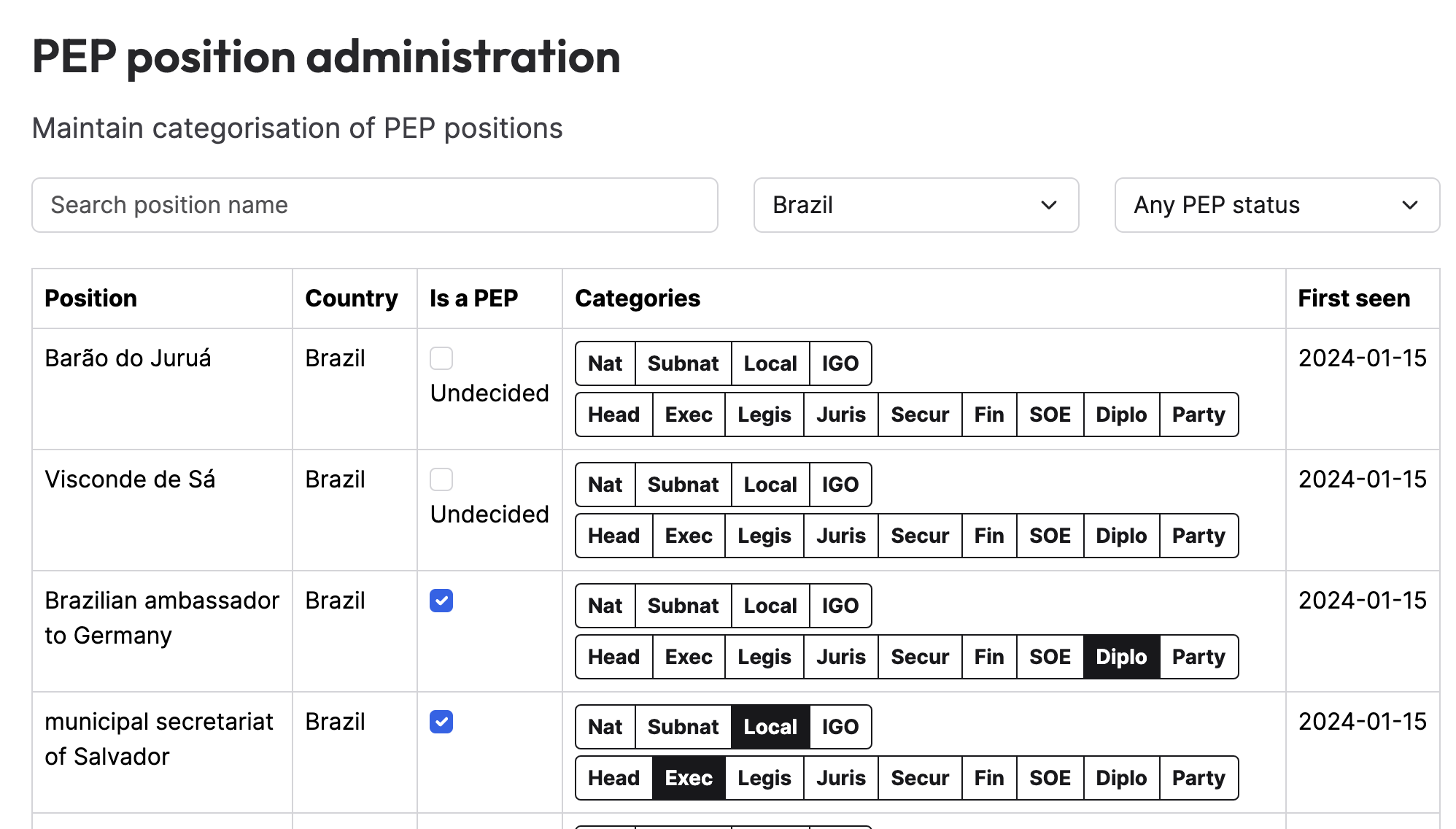
To allow newly discovered positions to be added to the database, and to use the
is_pep value from the database, call zavod.stateful.positions:categorise with the Position.
If the data source is known to only include PEP positions, or if the crawler only
attempts to create positions known to be PEPs, default_is_pep should be True — which
is the parameter's default, so plain categorise(context, position) is the idiomatic
call and passing default_is_pep=True is redundant. Pass default_is_pep=None
explicitly when the position should instead be categorized manually in the database.
Only make occupancies and emit entities for which the returned categorisation.is_pep is True.
See the example below.
With default_is_pep=None, a not-yet-reviewed position returns is_pep=None and
its holders are not emitted. A new crawler against an uncategorized source then
produces no PEP output until someone sets is_pep in the review UI, and only the
next crawl picks those people up. Use None only when the source genuinely mixes
PEP and non-PEP roles; when the source is known to consist entirely of PEPs,
True is correct.
Positions are created in the database if they don't already exist, and can be
categorized manually later. The is_pep and topics values from the database
are then used during crawling and enrichment
respectively.
zavod.stateful.positions.categorise(context, position, *, default_is_pep=True)
cached
Return the reviewed categorisation (topics, is_pep) for a position.
If the position has already been reviewed, the reviewed values are
returned and override default_is_pep and the topics on the entity.
Otherwise, the position is enrolled into the review UI with the
crawler-supplied topics and default_is_pep, and those defaults are
returned; later calls will pick up any edits made through the UI.
Source code in zavod/stateful/positions.py
zavod.stateful.positions.PositionCategorisation
Source code in zavod/stateful/positions.py
is_pep = is_pep
instance-attribute
Whether the position denotes a politically exposed person or not
topics = topics
instance-attribute
The topics linked to the position, as a list
Creating occupancies
Occupancies represent the fact that a person holds or held a position for a given period of time. If a person holds the same position numerous times, emit an occupancy for each instance.
For most positions, someone holding a position becomes less and less significant over time.
It becomes less important to carry out anti money-laundering checks on people the
more time has passed since they held a position of influence which could enable
money laundering. A person is therefore represented as a PEP only if a data source
indicates they hold the position now, or they left the position within the past 5
years. In these cases the occupancy status should be current or ended respectively.
If the data or the source's methodology makes it unclear whether a position is
currently held, someone is considered a PEP if they have not died and entered the
position within the past 40 years. In this case the occupancy status should be
unknown.
When the source records that a person has died or left office mid-term, set their
deathDate (on the person) and the occupancy endDate, rather than skipping them.
make_occupancy applies the thresholds above and returns None once the person no
longer qualifies, so a recently deceased or recently removed office holder is still
emitted with an ended occupancy, while one who left long ago is dropped automatically.
Date each occupancy. Use startDate/endDate for a person's own mandate (a member who
left mid-term, or any source giving per-person dates); use periodStart/periodEnd for
whole-term membership, where you only know the term's bounds and they are identical for
everyone who served that term. The two can coexist, and make_occupancy treats an
individual end date as the more specific signal. If neither is known, electionDate can
stand in as a fallback for inferring exposure.
Pass no_end_implies_current=False for sources that don't reliably remove people when
they leave office (static snapshots, scraped archives), so an occupancy with no end date
resolves to unknown rather than current. Leave the default (True) only when the
source is actively maintained and can be trusted to drop departed office-holders.
Let make_occupancy derive the status from these dates; do not pass status="ended"
yourself when you have an end date. Override status only when the source states that a
mandate is current or ended but gives no date to derive it from.
Only emit if the person is a PEP
Occupancies and positions should only be emitted for instances where these conditions are met. Persons should only be emitted if at least one occupancy exists to indicate they meet the criteria for being considered a PEP.
The make_occupancy helper returns occupancies
only if they still meet these conditions, taking the PEP duration
into account. Use it to create occupancies, set the correct status
automatically, and determine whether the occupancy meets the criteria and should
be emitted.
Example
# ... looping over people in a province ...
person = context.make("Person")
source_id = person_data.pop("id")
person.add("name", person_data.pop("name"))
person.add("citizenship", "us")
# Set deathDate rather than skipping the person; make_occupancy decides PEP status.
h.apply_date(person, "deathDate", person_data.pop("death_date", None))
# ... more person properties ...

for role in person_data.pop("roles"):
    position = h.make_position(
        context,
        f"Member of the {province} Legislature",
        wikidata_id="Q....",
        country="us",
        subnational_area=province
    )
    categorisation = categorise(context, position)
    if not categorisation.is_pep:
        continue
    occupancy = h.make_occupancy(
        context,
        person,
        position,
        start_date=role.get("start_date", None),
        end_date=role.get("end_date", None),
        categorisation=categorisation,
    )
    if occupancy is not None:
        context.emit(occupancy)
        # Emitting the position and person multiple times is a bit wasteful
        # but not harmful:
        context.emit(position)
        context.emit(person)
One person, several positions
Some role labels imply more than one held office: a parliament's Speaker is typically elected from among the members and keeps their seat, so they hold the Speaker office and the plain membership at once. Create an occupancy for each held position, not just the most senior one — each is politically exposing in its own right.
Where the source labels the role, a position lookup option with multiple values
(see result values) maps the label
to all held position names declaratively; the crawler then loops over
context.lookup(...).values, applying the pattern above to each name. Worked example:
examples.md → "One label, several held positions".
Historical and multi-term sources
Current office holders are the priority, but when a source also exposes past terms cheaply (the same table, or a per-term archive), it is worth crawling them. A national legislator remains politically exposed for years after leaving office, so several terms still matter.
Two mechanisms divide the labor:
earliest_term_startbounds how far back you crawl: skip fetching whole terms or archive pages older than the PEP-relevance window. The only thing it buys you is the crawl you avoid, so there is no point applying it to terms you would fetch anyway;make_occupancygates those records more precisely. Log a skipped term atinfo; it is a deliberate gap, not something the crawler team can fix.make_occupancyis the decider on whether political exposure still applies, per occupancy. The cutoff is deliberately more generous than this window, so it never skips a term whose members would still qualify.
Date each occupancy as described in Creating occupancies. Whole-term
archives are the typical case for periodStart/periodEnd (the same term bounds applied to
everyone who served), while a source giving per-person dates uses startDate/endDate.
Relatives and close associates
Relatives and close associates (RCAs) are rare in PEP sources but valuable under AML regimes: the family members and close associates of a politically exposed person warrant the same enhanced scrutiny. When a source links a PEP to such a person, model the relationship:
- Emit the relative or associate as a Person carrying the
role.rcatopic, notrole.pep: their exposure comes from the relationship, not from holding office. They get no Position or Occupancy. - Link them to the PEP with the relationship entity that fits the source:
- Family for kinship: set
personto the PEP andrelativeto the family member. - Associate for a known non-family relationship, such as a business partner or
close friend: set
personto the PEP andassociateto the other party. - UnknownLink only when the source asserts a connection whose nature is unclear:
set
subjectandobject.
- Family for kinship: set